

Regardless of your opinion on reality TV, it’s impossible to deny that it has a magnetic, often hypnotic pull on those who follow it with an almost religious zeal. There’s heated debate on whether it truly is as ‘real’ as producers would have us believe, or if every single thing we see on our screens is manipulated and crafted to create a reality that they would have us believe is actual fact. It’s all about viewership and ratings, and at the end of the day, if people keep watching, they’ll keep broadcasting.
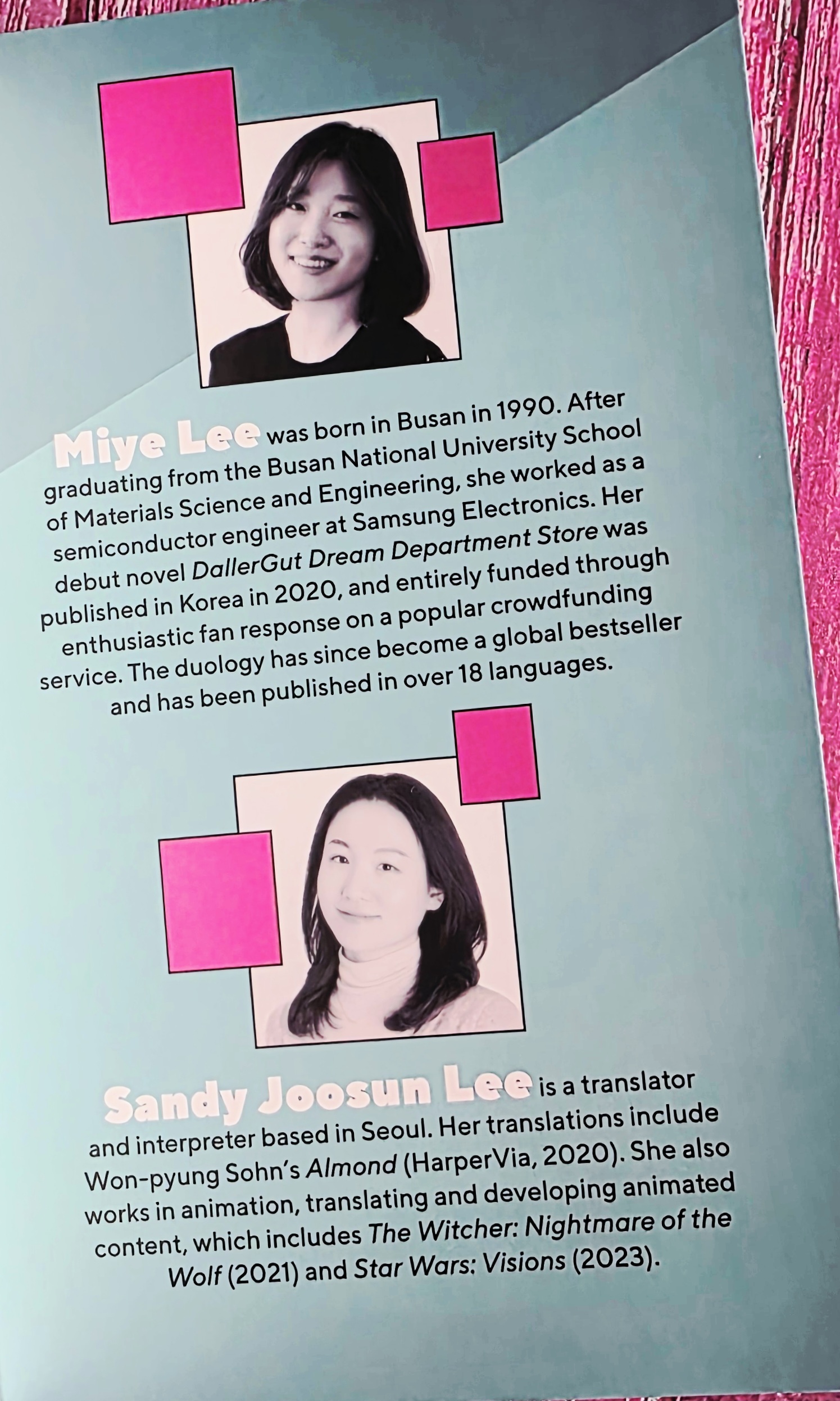
Break Room is by Korean author Miye Lee and translated into English by Sandy Joosun Lee. It is presented in book format of 140 pages. However, I was surprised to discover that the story itself comprised of just ten chapters … only 83 pages. The remainder of the book was made up of a welcome, the author and translator’s notes and a 40-page extract from the author’s previous work, Dallergut Dream Department Store (which is apparently a well-known Korean literary phenomenon). Personally, I would have appreciated a glossary explaining the many food descriptions that were scattered throughout – yes, I know that I can easily Google these, but I did feel that by constantly having to stop and check a translation, I was reading in stops and starts. Having a glossary or some sort of referral system in the actual book might make this a lot smoother for those who aren’t so familiar with Korean food.
The story starts off with a Wikipedia explanation of what Break Room actually is … the TV show, not the actual break room where staff spend their work breaks:
“Break Room (Korean: 탕비실) is a South Korean reality competition TV series on QBS created by producer Lee Il-Kwon. The first season aired every Friday from 10 February to 17 March 2023.“
Eight individuals find themselves invited to participate in a seven-day reality show where they’ll spend time in what I would describe as an alternate reality! There’s a communal area – the Break Room – and each participant has their own private space which consists of a sleeping area and a work area, which is set up exactly like the office workspace in their actual office. The rules are explained to them, and it’s then disclosed that they’ve each been elected by their colleagues because they are the person that they would least like to share a break room with! Basically, instead of being chosen because they’re popular amongst the people they work with – the opposite is true. It’s quite a blow!
Of the eight, only five decide to participate in the filming of the show. Their real names are not used. Instead, they go by the nicknames given to them, according to the annoying habits described by the work colleagues who sent them here:

Who is the worst office villain?
A villain who owns two dozen Tumblers as a self- proclaimed environmentalist, but leaves them unwashed in the shared sink?
A villain who hoards the most popular brand’s Coffee Mix sticks at their desk?
A villain who loves to regularly deliver a Monologue in the break room? A villain who clutters the shared fridge with Cake Boxes they never take home?
Or our narrator, a villain who fills the communal Ice Cube tray with cola and coffee?
Actually, only four of these is really an office villain. One of them is a “mole” and it’s up to the others to discover who that is. How will they do that? They need to break the rules, and each time they do this, they’ll earn themselves a hint about one of the others that will arm them with sufficient information about their opponents. But … there’s also an opportunity to acquire hints about themselves: they’ll be able to find out what their colleagues out there in the real world think about them and what they have to say about them. Wow! It’s quite a bombshell when you think about it – the chance to know what people who you spend every day with really think about you!!
I’ll be honest, the book itself is flimsy. There’s not a lot of depth to the plot or to the characters, and it all falls a bit flat. But where it does deliver is as a wake-up call to how cancel culture quickly grows and evolves; how we perceive others and their actions, especially those who we interact with on a regular basis. Those dislikes we hold so dear, for no reason whatsoever, those misunderstandings that we insist aren’t our fault, those slights that we’re determined to dwell on and twist out of proportion. We tend to cling on to all of these tighter than to the really important stuff, and by doing so, we miss out on the things that will bring genuine connection, joy and excitement into our lives. If anything, this book should be a conversation starter that leads us to those connections.
Thank you to Jonathan Ball Publishers for my review copy.

 jansbookbuzz.com
Leave a comment